

Draw the Map
025 ⎟ The Futurist Edit


Hello Futurist,
If you’re like me, you collect signals constantly (bookmarking articles, screenshotting posts, saving images) but when it’s time to find something, how do you scroll through all that good stuff? A common problem we face as information gatherers is that we sometimes scan without structure, which means we're not only drowning in noise we can't navigate, but we're also missing entire territories worth exploring.
Here’s what’s inside today’s issue:
The Tool: A simple framework that tells you where to look, what not to miss, and how to organise what you find.
Step Into the Future: We apply the tool to skincare rituals, building an example that shows how the tool translates from theory to practice.
Back to the Present: Tactical steps to draft your own map, set up your scanning system around it, and turn signal chaos into intelligence you can actually use.
Let’s jump right in.

THE TOOL
✦ What Are We Talking About? ✦
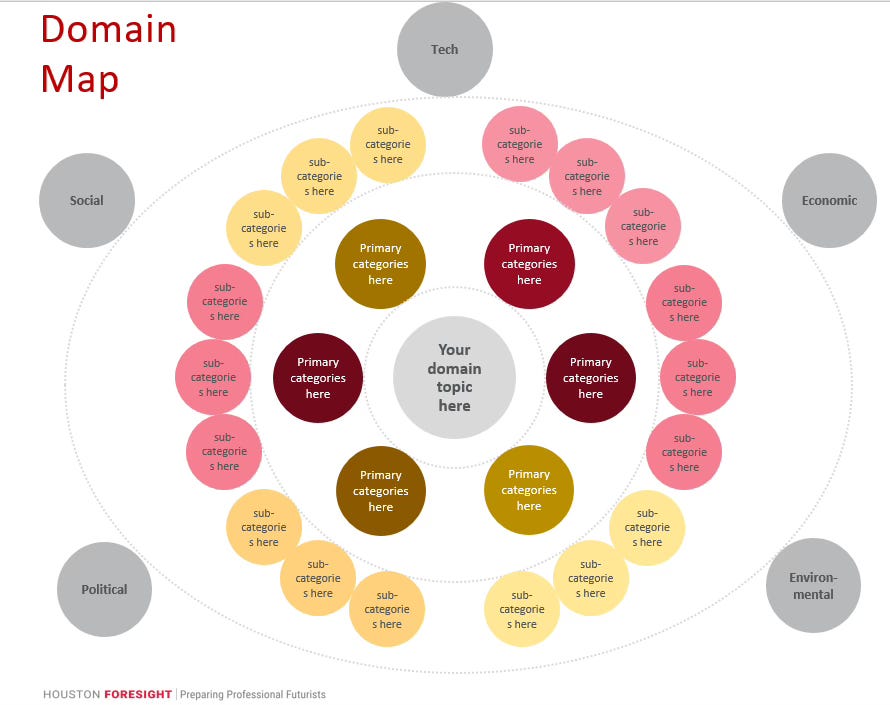
Andy Hines, a futurist who’s been teaching strategic foresight for decades, has a deceptively simple tool that changed how I approach scanning. Called the Domain Map, it essentially is a category-based framework that maps out the major aspects of whatever future you’re trying to understand. Think of it as your scanning compass: it tells you where to look, what not to miss, and how to organise what you find.
Hines developed this as part of his foresight methodology in the early 2000s, refining it through countless client projects. And what makes it so appealing is that it forces clearer thinking before you start scanning.
✦ How It Works ✦
The process is straightforward:
Start with our domain - We place it at the center of our map.
Identify 6 main categories around it - These are the big buckets that define our domain. The key here is staying at the category level. We resist the urge to jump to specifics yet.
Add subcategories under each - This is where we go a layer deeper and break down what sits inside each main category. Three to five subcategories per main category usually does it. We’re still thinking in buckets, not specifics here.
Use it for scanning - The categories and subcategories become our search terms when we scan. They also become our tagging system. If we’re building a signals library with 500+ items (which adds up faster than you’d think), good tagging is the only thing standing between us and chaos.
The whole thing should be viewable at a glance.
✦ Why It Matters ✦
When scanning we tend to leap straight to the concrete when we should be thinking in categories first, the Domain Map is here to:
Gives us peripheral vision. We’re not just tracking the obvious shifts but also the context those innovations live within.
Makes scanning manageable. We’re not drowning in a feed of everything vaguely related to our topic. We’re systematically covering our bases, tagging as we go, and building a library we can actually navigate when we need to pull insights for a project.
Becomes a communication tool. A shared map creates a common language. It helps teams and stakeholders see the full scope of a topic without getting lost in specifics.

STEP INTO THE FUTURE
Let’s apply the Domain Map to skincare rituals, a space where product innovation, cultural shifts, and wellness converge. Below I’ve identified five main categories that define skincare rituals, each broken down into subcategories that can guide future scanning and signal tagging.
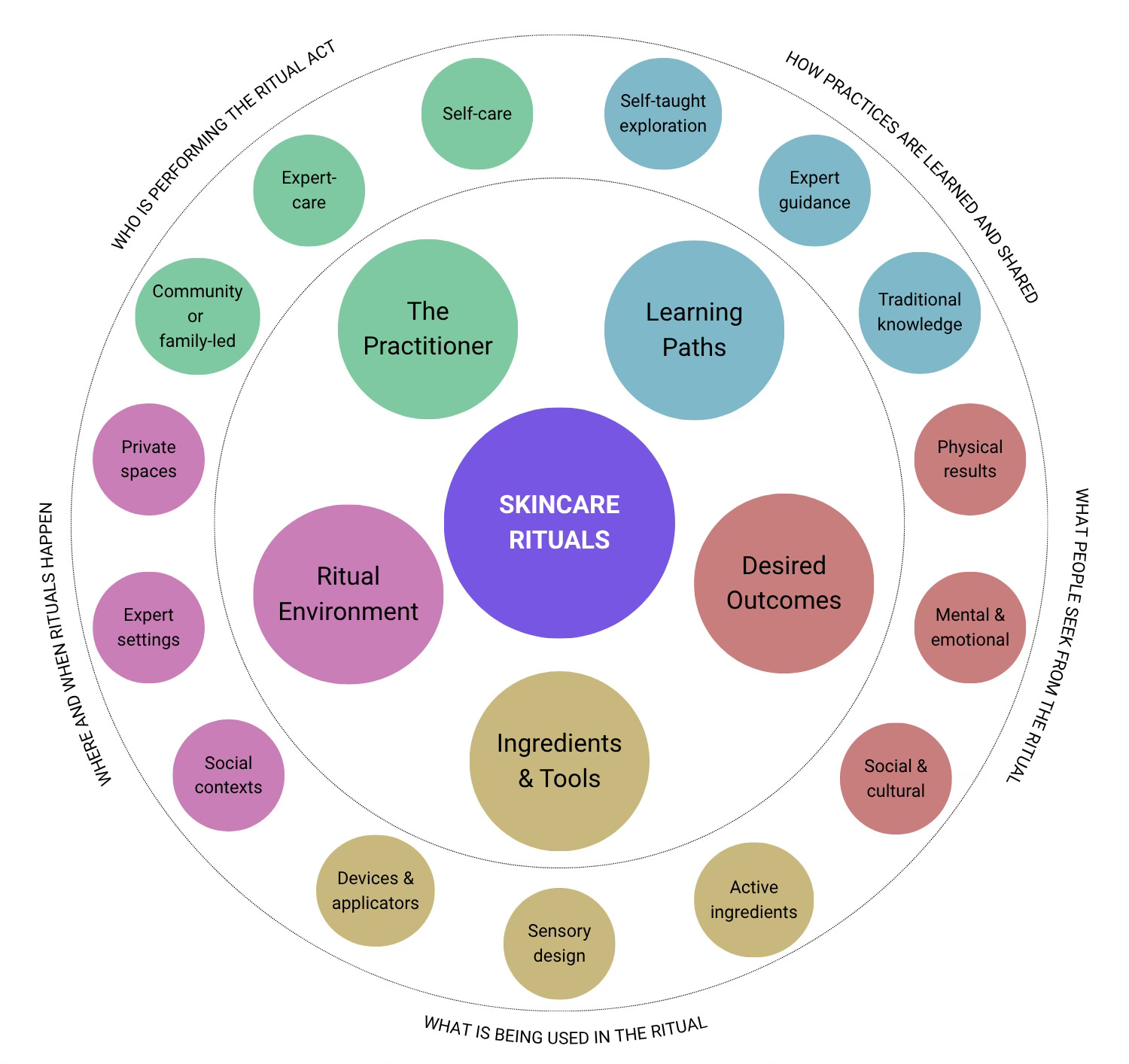
Each category and subcategory translates into search terms and tags, helping us capture signals across the full domain. Here’s how it breaks down:
