

The Foresight Mix
027 ⎟ The Futurist Edit

Hello Futurist,
If you have a marketing background like I do, when I say 4 P’s, you probably think about the marketing mix: Product, Price, Place, Promotion. The 4 P’s we’ll talk about today have nothing to do with those, but they are equally useful. Just as the marketing ones gave us a shared language to sell what already exists, the foresight ones give us a way to navigate what doesn’t exist yet.
Here’s what’s inside this issue:
The Tool: what the 4 P’s in the Cone of Possibilities actually are and how to sort a signal into the right P.
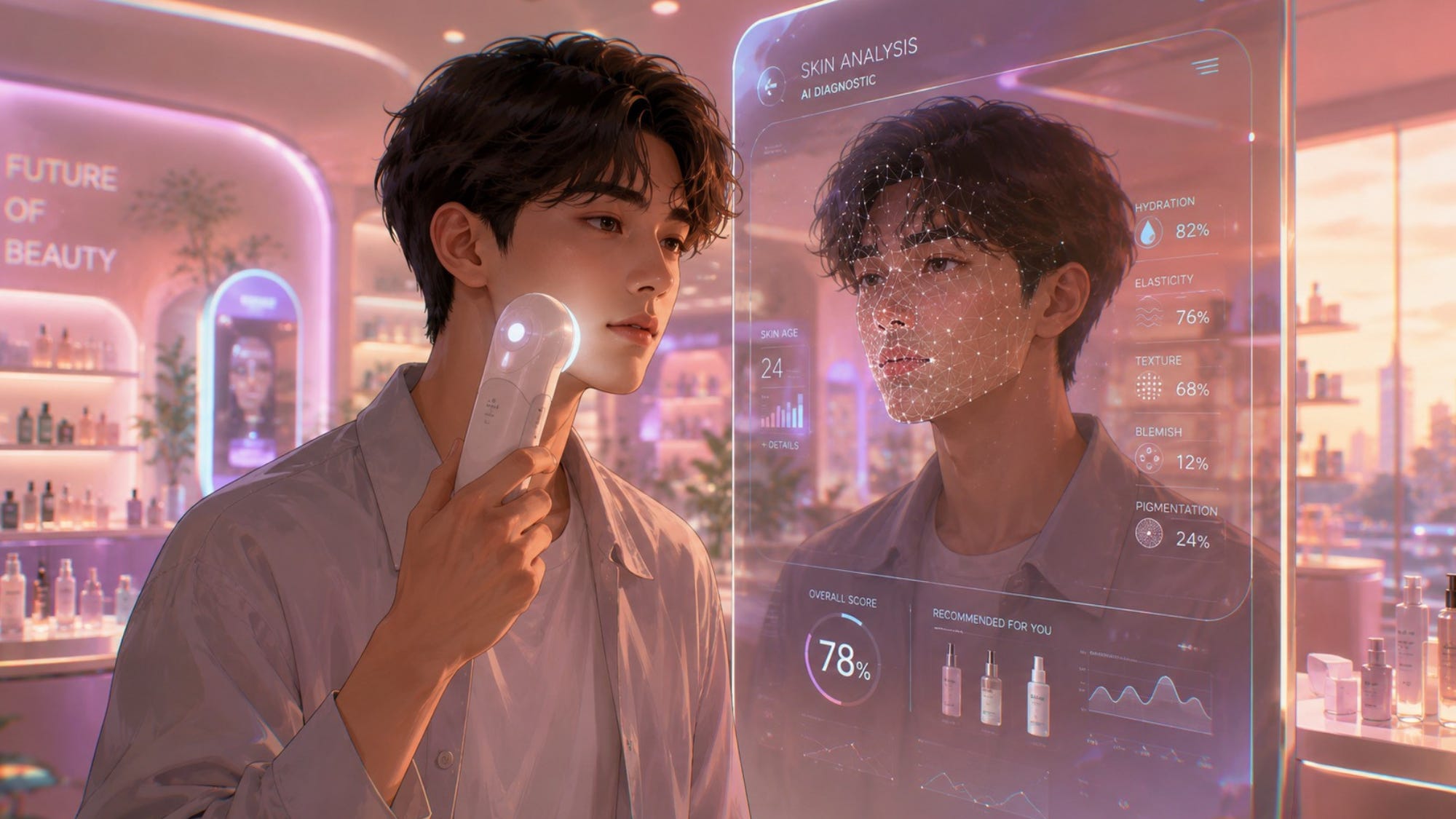
Step Into the Future: a horizon scan on AI beauty advisors, fifteen real signals, sorted into five clusters, mapped onto a cone.
Back to the Present: a ring-by-ring strategy for what to build now, what to watch, and a set of questions you, only, can answer.
Let’s jump right in.

THE TOOL
✦ What Are We Talking About? ✦
The 4 P’s come from future studies. First with futurist Roy Amara, who layed out three of the four Ps: Possible, Probable, Preferable in 1981 as he was president of the Institute for the Future. A few years later, Clement Bezold added the fourth, Plausible, and along with Trevor Hancock gave the whole model its now-familiar shape, a cone widening outward from the present. That shape, the Cone of Possibilities, is still the standard way foresight consultants visualise the framework today.
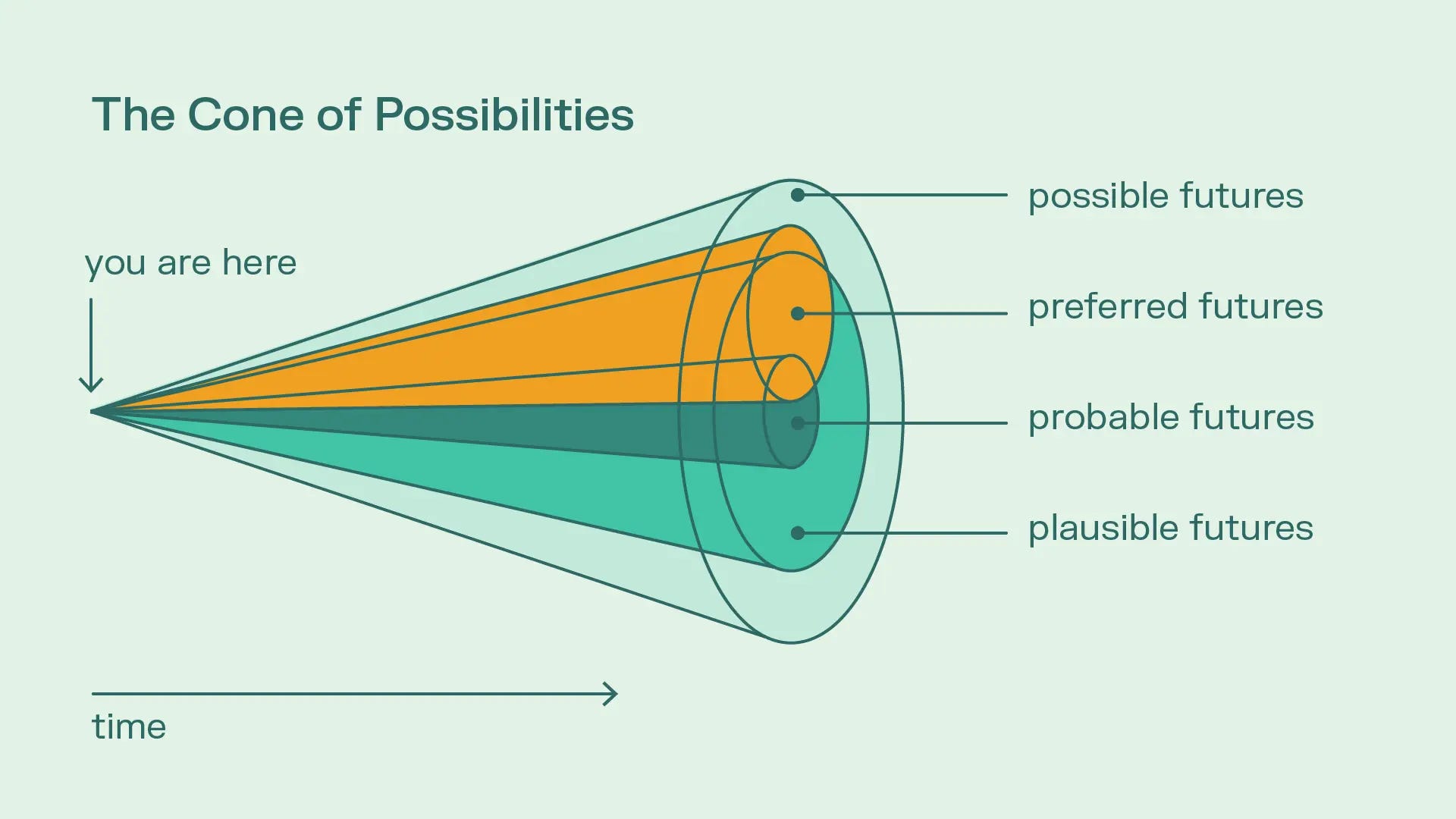
We’ve explored the Cone before in this newsletter, but today we’re going deeper into something we only touched on: how to actually categorise a signal into the correct P.
✦ How It Works ✦
The cone starts at a single point: today. As you move away from that point, the futures inside it get wider and less certain.
Possible ➡ What could happen, given what we know or can imagine?
The widest ring. Includes anything not violating the laws of physics (even wildcards and low-probability futures). This is the "no idea is too strange yet" zone. Almost nothing gets excluded here.
Plausible ➡ What could happen, based on current knowledge?
Narrower than possible. These are futures that make sense given how systems, science, and culture currently work, even if we’re not sure if or how they will happen. This is where credible speculation happens, but based on logic, not imagination.
Probable ➡ What will likely happen, if trends continue?
Narrower still. This is extrapolated by taking current trajectories (market data, tech maturity curves, regulatory momentum) and projecting them forward. It is the “safe bet" zone, but it’s getting increasingly challenged by polycrisis and the rise of wild cards.
Preferable ➡ What do we want to happen?
This one cuts across the other three. It’s not about likelihood at all, but rather about asking what future serves our values, our brand, our consumers best. This space is where imagination and strategy work hand in hand.
Each ring is a stricter filter on the last, and Preferable breaks that pattern entirely.
So how do we actually sort signals into one of these rings?
Horizon scanning: we gather concrete, dated evidence (patents filed, startups funded, pilot programs launched, fringe behaviour already showing up online).
Clustering: we group signals that point in the same direction, so that we are categorising a pattern, not a one-off headline. A single topic can usually hide several distinct threads pulling in different ways, so we have to be mindful of that too.
Ring assignment: we ask ourselves how strong the evidence is, is the science or tech proven or still theoretical? And how much consensus sits behind it, is one lab pursuing this alone, or are several independent players converging on the same idea?
Strong evidence, high consensus plus a short horizon = Probable.
Credible but less committed, or with a murkier timeline = Plausible.
A genuine leap, or a convergence that hasn’t happened yet = Possible.
Preferable is sorted differently. There’s no evidence test here, we’re asking what would actually serve our industry or our consumer well, then checking which ring that desirable future currently sits in. Sometimes the answer can be that the future we’d actually want turns out to be the least probable one on the map.
✦ Why It Matters ✦
Mastering the 4 P’s is a valuable upgrade to how we read the market and communicate strategy.
We get a clearer view: signals stop being a random compilation of headlines and start being organised into something we can actually reason with, which makes patterns more visible.
We get to choose where to focus: short-term bets can be in Probable, while long-term positioning can be built around Preferable, so we’re not treating every future as equally urgent or equally worth pursuing right now.
We stay protected from tunnel vision: without the 4 P’s, it’s easy to over-invest in whatever feels most likely and miss the slower-moving futures building in Plausible or Possible.

STEP INTO THE FUTURE
Now let’s apply the 4 P’s to AI beauty advisors, starting with a horizon scan of what’s happening in the field. Here are the 15 signals I’ve gathered:
Swan Beauty’s $795 smart mirror scans seven skin parameters and positions itself as a full "beauty advisor and companion", expanding into 21 retail locations in 2026.
Becon, a Samsung-invested device, uses a single AI-powered scanner to analyse both skin and scalp, generating product recommendations directly integrated with a salon or clinic’s CRM.
Aram Huvis’s AI Scalp Grader, developed with Seoul National University Bundang Hospital, delivers evaluations, personalized insights, and data-driven care recommendations.
