

The Morph Factor
022 ⎟ The Futurist Edit


Hello Futurist!
In foresight, scenarios are a cornerstone. They are a great way to anticipate change, challenge assumptions, and build strategies that can adapt as the future takes shape. Today, we’re exploring a tool to help create scenarios more systematically and creatively: the morphological analysis method.
What you will find inside today’s issue:
The Tool: discover a structured methodology to map key drivers and explore multiple futures.
Step Into the Future: see how this approach can be applied to envision what the makeup industry could look like in 2035.
Back to the Present: learn how to make the most of this tool and make foresight work for your business.
Let’s jump right in.

THE TOOL
✦ What Are We Talking About? ✦
Morphological Analysis is one of those classic foresight methods that looks deceptively simple but has real range. It was developed in the 1950s by astronomer Fritz Zwicky as he needed a structured way to explore the unknown. Instead of predicting one outcome, he looked at all the possibilities by breaking a system into parts and mapping how each part could evolve.
Over time, futurists adapted Zwicky’s method into practical formats, like morphological charts or futures tables, but the heart of the tool remains the same: identify the key variables of a system, imagine the different ways each variable might develop, and combine them to build contrasting future scenarios.
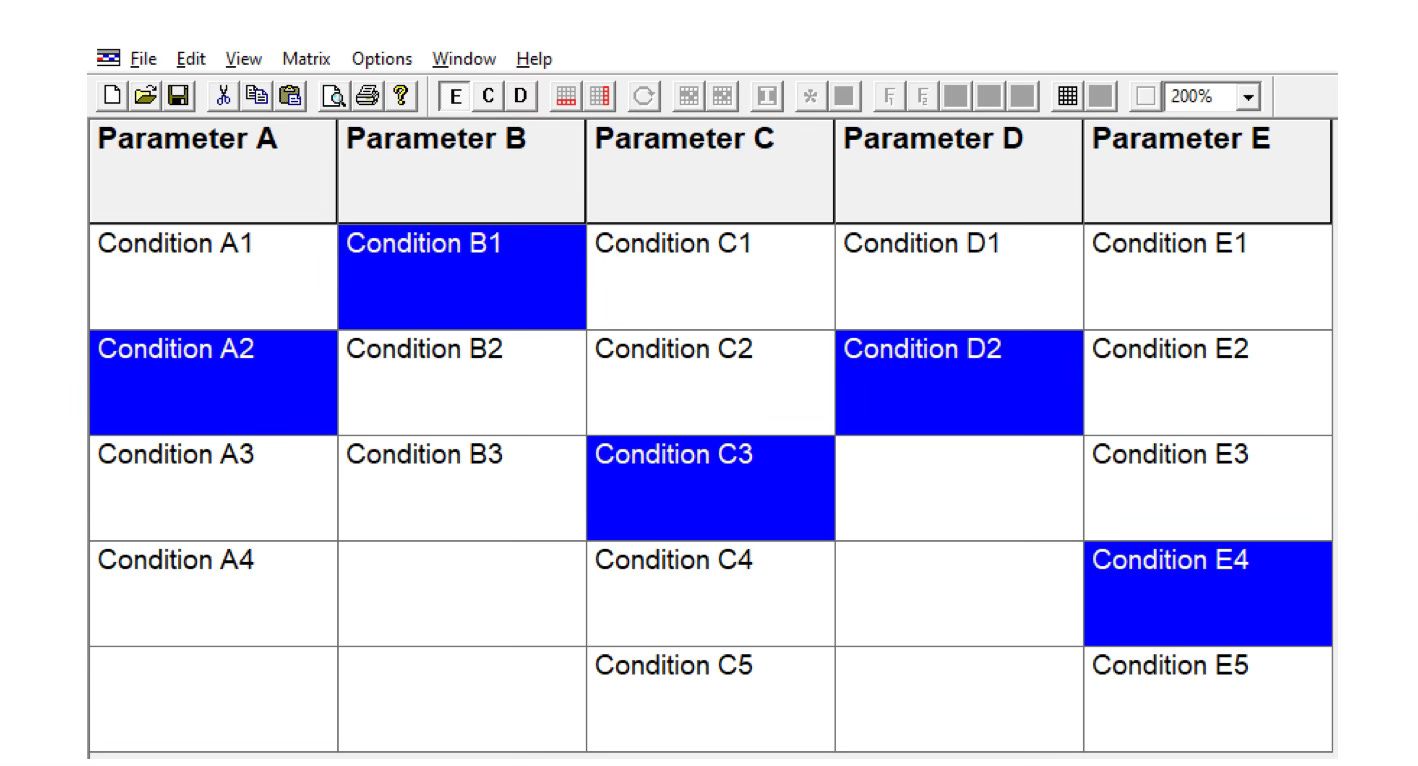
✦ How It Works ✦
Morphological analysis is a way to explore how different forces could combine to create very different futures. Here’s a simplified process of the methodology:
Define the question and horizon → It should be specific. What future are we exploring, and by when?
Choose our variables → We then search for the main drivers that shape the topic. We can use a checklist like STEEP (Social, Technological, Economic, Environmental, Political) to make sure we cover different domains.
Create the morphological chart/table → We set up a table in a spreadsheet.
Rows = variables (ordered from most to least influential or from specific to general).
Columns = possible development/direction hypotheses (short, expressive statements).
Combine hypotheses → We select one hypothesis per row to form a combination. Each combination becomes a candidate future image. We don’t need every possible combo; we should focus on the most meaningful mixes.
Draft scenarios → We turn each coherent combination into a readable story, using plain language, a clear timeline, and a catchy title.
✦ Why It Matters ✦
Morphological analysis gives a solid foundation for building scenarios and helps us understand a topic more deeply before exploring its future:
By researching multiple variables, even those not directly connected, we uncover the full complexity of a topic.
By revealing hidden possibilities, it helps us imagine futures that are not immediately obvious.
By challenging biases, we step away from assumptions and habitual thinking to explore a wider range of plausible outcomes.

STEP INTO THE FUTURE
Let’s explore the future of makeup. First I’ve mapped out key variables shaping the industry and identified three possible ways each could develop (this is just one set among many possible variables and directions we could choose from):
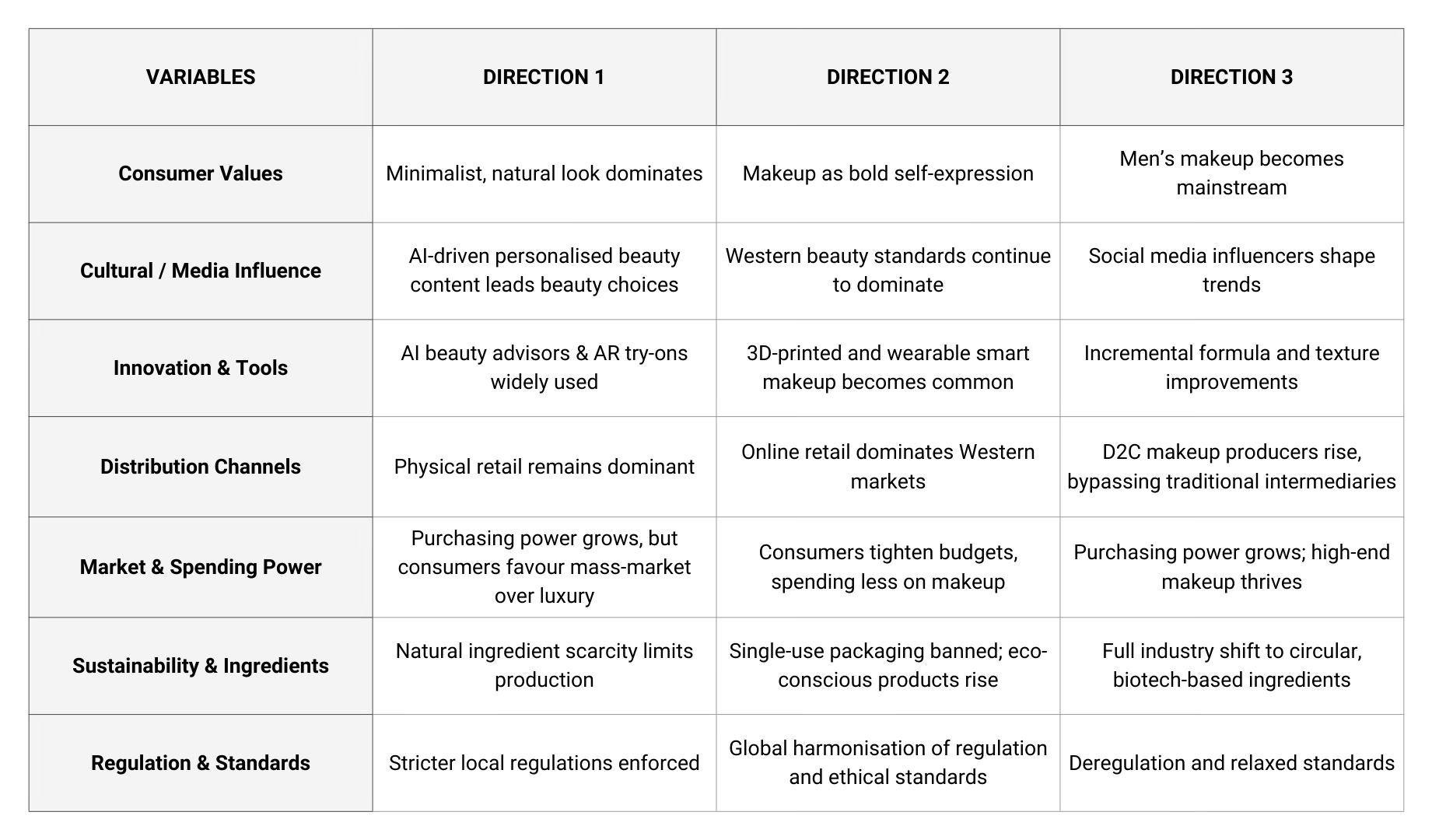
Next, I’ve combined one direction from each variable to create three contrasting scenarios, each represented in the table below with a colour-coded view:
